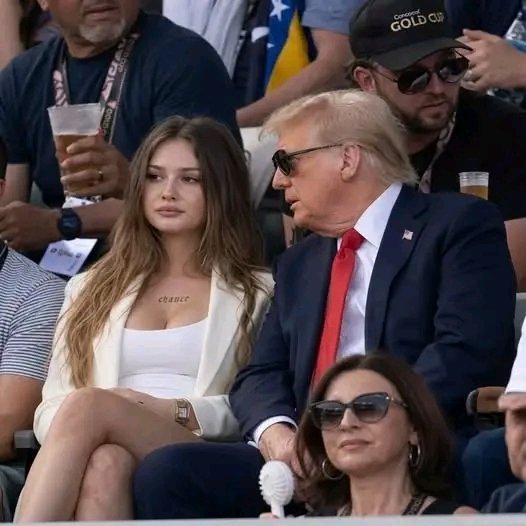
A photograph of the president of the United States, Donald Trump, sitting next to a young woman during a sporting event has begun to spread massively on Facebook, X, Instagram, and TikTok accompanied by the eye-catching message: “Donald Trump tried to win over a woman at the Football World Cup”. The image has generated millions of views and thousands of comments, as many users interpreted that the president was having a conversation with the young woman during the match.
As with much viral content, the post uses a suggestive headline that leaves room for speculation and sparks the curiosity of the public. Within a few hours, all kinds of versions began to appear, from those who claimed that Trump was trying to flirt with the woman to those who stated that it was simply a casual conversation caught on camera.
Images of political figures at sporting events usually become trends quickly due to the enormous media attention they receive. On this occasion, the combination of Donald Trump, an unknown young woman, and a major international tournament was enough to trigger millions of interactions on social media.
But what really happened? Does the photograph prove that Trump tried to win over the young woman? Is there evidence to support that claim? This is what can actually be verified.
The photograph that sparked the controversy
The image shows Donald Trump sitting in the stadium stands during a Football World Cup match. Next to him appears a young woman dressed in a white blazer and a light-colored t-shirt while watching the field of play.
In the photograph, Trump appears to slightly lean his head in the direction of the woman, a circumstance that was used by numerous posts to insinuate that both were having a personal conversation.
However, a still image only captures a fraction of a second and does not allow us to know what was happening before or after that instant.
What exactly does the viral post claim?
The message spread on social media claims that Donald Trump allegedly tried to win over or flirt with the young woman during the match.
However, the post does not present:
A complete video of the moment.
Statements from Trump.
Statements from the woman.
Testimonies of people present.
Official information about the identity of the young woman.
Evidence to confirm the interpretation made.
In other words, the claim is based solely on a photograph taken from a certain angle.
Can a photograph prove a conversation?
No.
An isolated image does not allow us to know the content of a conversation or the intentions of the people photographed.
Visual communication specialists explain that a photograph can capture gestures, postures, or looks, but it does not constitute sufficient evidence to state what the protagonists were saying or what the full context was.
Interpreting the content of a conversation solely by looking at a photograph can easily lead to wrong conclusions.
The risks of taking conclusions out of context
Nowadays, it is very common for images of public figures to be used to build narratives completely different from the original facts.
A photograph can be taken during an institutional conversation, a protocol greeting, or a simple exchange of words related to the event, but later spread accompanied by a sensationalist headline that completely changes its meaning.
Precisely because of this, specialists recommend always analyzing the context before drawing conclusions.
Who is the young woman in the photograph?
The viral post does not officially identify the woman appearing next to Donald Trump.
It also does not explain what her role was at the sporting event or why both were sitting in close proximity.
Without this information, it is impossible to establish any responsible interpretation of the scene captured by the camera.
Images of political leaders often go viral
Donald Trump remains one of the most recognized political figures in the world.
Each of his public appearances receives massive media coverage, especially when he attends sporting events of great international importance.
The cameras tend to focus on him constantly, which increases the probability of capturing images that are later used in viral posts.
What is clickbait?
The strategy used in this type of post is called clickbait.
It consists of using exaggerated, ambiguous, or eye-catching headlines to get users to click on a link.
Phrases like:
“You won’t believe what he did.”
“He tried to win her over.”
“The reaction surprised everyone.”
“Look at what happened.”
“Minutes ago.”
“The truth came to light.”
seek to spark immediate curiosity even if the content later does not actually confirm the initial statement.
The importance of context
When a photograph is shared without the full video, without official statements, and without information about the exact moment it was taken, it is very difficult to correctly interpret what happened.
Digital verification professionals insist that an image should never be analyzed in isolation.
It is always necessary to check the full context, the original source, and the sequence of events.
What happens during sporting events?
In international competitions, it is common for authorities, special guests, sports directors, sponsors, and personalities to share the same VIP areas of the stadium.
During these meetings, it is normal for attendees to have brief conversations related to the development of the event, the organization, or even simple courtesy greetings.
Therefore, the fact that two people are sitting next to each other does not automatically lead to the conclusion that there is any kind of personal relationship.
How to verify posts of this kind
Before sharing a viral photograph related to public figures, it is advisable to follow some basic steps:
Search for the full video of the moment.
Check if there are official statements.
Consult reliable media outlets.
Identify when and where the image was taken.
Avoid drawing conclusions solely by looking at a photograph.
These measures help reduce the spread of rumors and misinformation.
The speed of misinformation on social media
Social media allows an image to reach millions of people in a matter of minutes.
When content involves globally known characters like Donald Trump, the speed of dissemination increases even more due to the enormous interest generated by their public activities.
For this reason, small video clips or isolated photographs can quickly become international trends without there necessarily being enough information to back up the claims that accompany them.
The importance of critical thinking
Digital literacy specialists recommend developing a critical attitude toward viral content.
Not every image shared on the internet reflects exactly what happened.
Many times, the real context turns out to be very different from the one suggested by the headline used to attract visits.
Contrasting information with multiple sources remains one of the most effective tools to avoid falling into misinformation.
Conclusion
The viral photograph shows Donald Trump sitting next to a young woman during a sporting event, but it does not constitute sufficient evidence to claim that he tried to win her over or flirt with her. The post does not present full videos, official statements, or proof to confirm that interpretation. An isolated image does not allow us to know the content of a conversation or the intentions of those who appear in it. Before sharing this type of content, it is advisable to consult reliable sources and analyze the full context to avoid contributing to the spread of unverified rumors or claims.