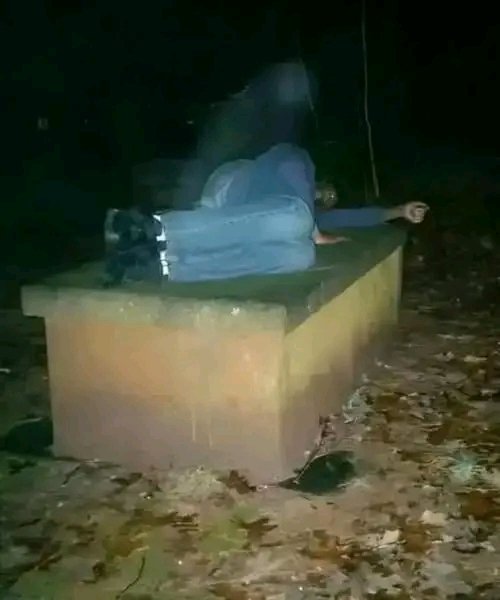
Every evening, as the world grew quiet and the last light faded from the sky, a man made his way down the worn path of a cemetery. His steps were slow, deliberate, and heavy with memory. He carried nothing but his grief — no blanket, no lantern, no flowers — just the unspoken weight of love that bound him to one particular grave. There, beneath the cool marble that bore his mother’s name, he would lie down and spend the night.
At first, people thought it was strange. Visitors whispered when they saw him stretched out across the grave, his head resting gently against the stone. Some assumed he had lost his mind, others believed he was trapped in despair. But as days turned into weeks, it became clear that what he was doing was not born from madness. It was devotion — quiet, unwavering, and heartbreakingly human.
To him, the cemetery wasn’t a place of death. It was the last space where he still felt his mother’s presence. As he lay there, surrounded by stillness and stars, memories filled the silence — her laughter, her voice, the warmth of her hand on his cheek. In those moments, the grave no longer felt cold. It became a bridge between what was gone and what still lived inside him.
He endured harsh nights that bit through his clothes, rain that soaked him to the bone, and the whispers of strangers who couldn’t understand. Yet he never stopped coming. He found peace there that he couldn’t find anywhere else — a kind of peace that defied logic, where grief transformed into quiet gratitude.
Over time, the cemetery caretakers grew accustomed to him. They’d nod in silent respect as he arrived at dusk and left at dawn. Even the local animals — a stray cat, the occasional bird — seemed to sense that something sacred lingered in that corner of the graveyard. The man’s presence, once unsettling, became part of the landscape itself — as constant as the morning dew and the evening breeze.
Then, one morning, something remarkable happened. He awoke before sunrise, stirred by a feeling he couldn’t quite explain. The air was different — alive, charged with something gentle and luminous. As he opened his eyes, he noticed a faint glow around his mother’s grave. It wasn’t bright enough to hurt his eyes, but it shimmered softly, as though the air itself was breathing light.
A warm wind brushed against his face, carrying with it a faint hum that sounded almost like a voice — not loud, not clear, but familiar. He felt his heart race and calm at the same time. It was as if his mother was there, not in body, but in essence. The grief that had kept him chained for so long seemed to dissolve in that moment. The years of heaviness began to lift, replaced by something new — release.
He didn’t speak. He didn’t need to. The silence said enough. He felt her presence, not as a haunting, but as comfort — a final assurance that love does not end, it only changes form. Tears rolled down his cheeks, but for the first time, they weren’t from sorrow. They were from understanding.
When the glow faded with the morning light, the man knew that something inside him had changed forever. He stood, steady and calm, feeling lighter than he had in years. For the first time since her passing, he was ready to let go — not of her memory, but of the pain that kept it chained to suffering.
Word of what happened spread quickly. Locals who had once pitied him now spoke of him with awe. Those who had dismissed his nightly visits as madness now saw them as proof of something sacred — a love so powerful that even death couldn’t silence it.
The story reached beyond the cemetery walls, touching people who had never met him. They saw in his devotion a mirror of their own griefs — the parents they missed, the partners they longed for, the children they still spoke to in dreams. His simple act of sleeping beside a grave became a universal story about what it means to love without end.
Over time, the man continued to visit, though not with the same desperation. Now, his visits were peaceful, full of quiet reflection rather than ache. He tended to the grave with care, planting small flowers and trimming the grass. The cemetery, once a place of sorrow, began to feel like a sanctuary — a place where life and death coexisted, each giving meaning to the other.
Those who passed by often saw him sitting upright now, not lying down as before. Sometimes he read aloud from a worn book. Other times he simply spoke into the air, telling his mother about his day, his regrets, his small joys. To outsiders, it looked like he was talking to himself, but to him, it was conversation — a continuation of love that no grave could silence.
Even the seasons seemed to shift around him. The flowers near his mother’s grave bloomed brighter. Birds nested in nearby trees. Whether it was coincidence or something beyond understanding, the air around that spot always felt a little different — softer, lighter. People began leaving their own offerings nearby: candles, notes, fresh blossoms. It became a quiet pilgrimage site, not of religion, but of remembrance
Reporters eventually heard the story. They came expecting to find a broken man, but instead, they found peace. “I’m not here because I can’t move on,” he told one journalist. “I’m here because moving on doesn’t mean forgetting. Love doesn’t stop when life does. I just needed time to understand that.”
Scholars, clergy, and grief counselors who read about his vigil began using his story as an example — of how mourning, when met with patience and purpose, can transform from sorrow into healing. They spoke of the man as a symbol of faith, not in doctrine, but in the endurance of the human heart.
He never sought fame or validation. His ritual remained personal, private, and profoundly sincere. Over the years, he came less often, but always with the same reverence. Each visit was a conversation between souls — one living, one gone, yet still deeply intertwined.
As he grew older, his nightly vigils became shorter. He’d sit for an hour, smile softly at the tombstone, and whisper words of thanks before leaving. He began to understand that love was never meant to chain him to the past, but to guide him toward peace.
One evening, as the sun slipped below the horizon, he said aloud the words he’d held in his heart for years: “You’re with me always, but it’s time for me to live.” The wind picked up, gentle and warm, like an answer. He smiled, knowing he had finally reached the balance between memory and freedom.
From that day forward, the man no longer slept at the grave. He didn’t need to. His mother’s presence was with him everywhere — in the laughter of children, in the rustle of leaves, in the stillness before dawn. Her love had become part of the world, part of him.
His story spread far and wide, touching hearts across the world. People who read about him were reminded that devotion is not measured by grief, but by the courage to love even after loss. He taught them that true connection transcends distance, time, and even death itself.
In the end, he found what every grieving soul searches for — peace. And through his quiet vigil, he left behind more than a story. He left a lesson: that love, when it is pure and unwavering, never truly ends. It simply changes where it lives.